





Cart

    Sorry, we could not find any results for your search querry.

    Plesk Tutorial Series 3: Updating your VPS

    This is the third part of our Plesk Tutorial Series. If you're configuring a new VPS we recommend starting with part 1.


    Plesk automatically installs most updates for Plesk and the software it uses, such as MariaDB. You do not normally need to update this software yourself.

    Software that is no longer supported is not present in Plesk by default. When your VPS is delivered, it comes with recent PHP versions and does not include unsafe older versions.

    No further action is required from you for Plesk updates. In this part, we focus on the following topics:

    • Adjusting the PHP version & settings
    • Plesk's automatic updates
    • Manually checking for updates


    Changing the PHP version and settings


    The PHP version on new installations is always up-to-date. Should you want to adjust the version per domain you can do so as follows:


    Step 1

    Log in to Plesk and navigate to 'Websites & Domains' > 'PHP Settings'.
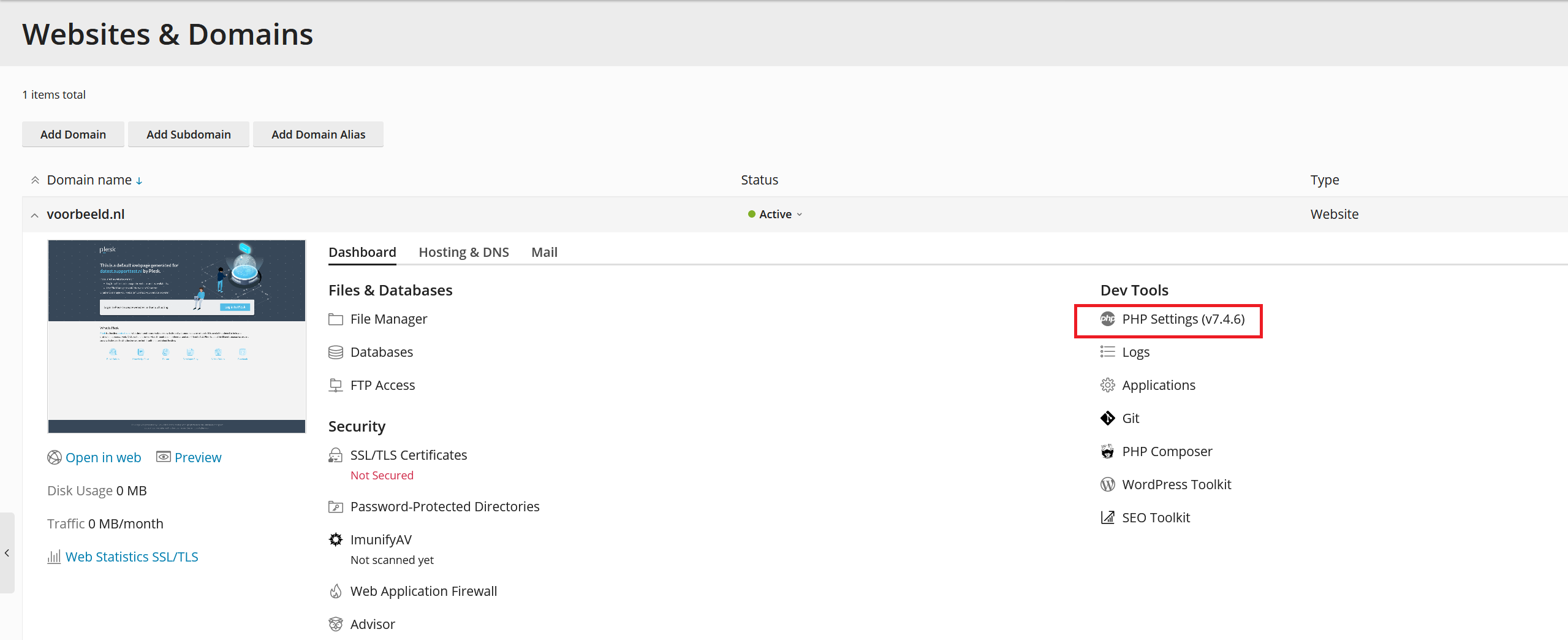
    plesk websites and domains php settings


    Step 2

    Change the PHP version to a version of your choice and at the bottom of the page click on 'Apply'> 'Ok'.
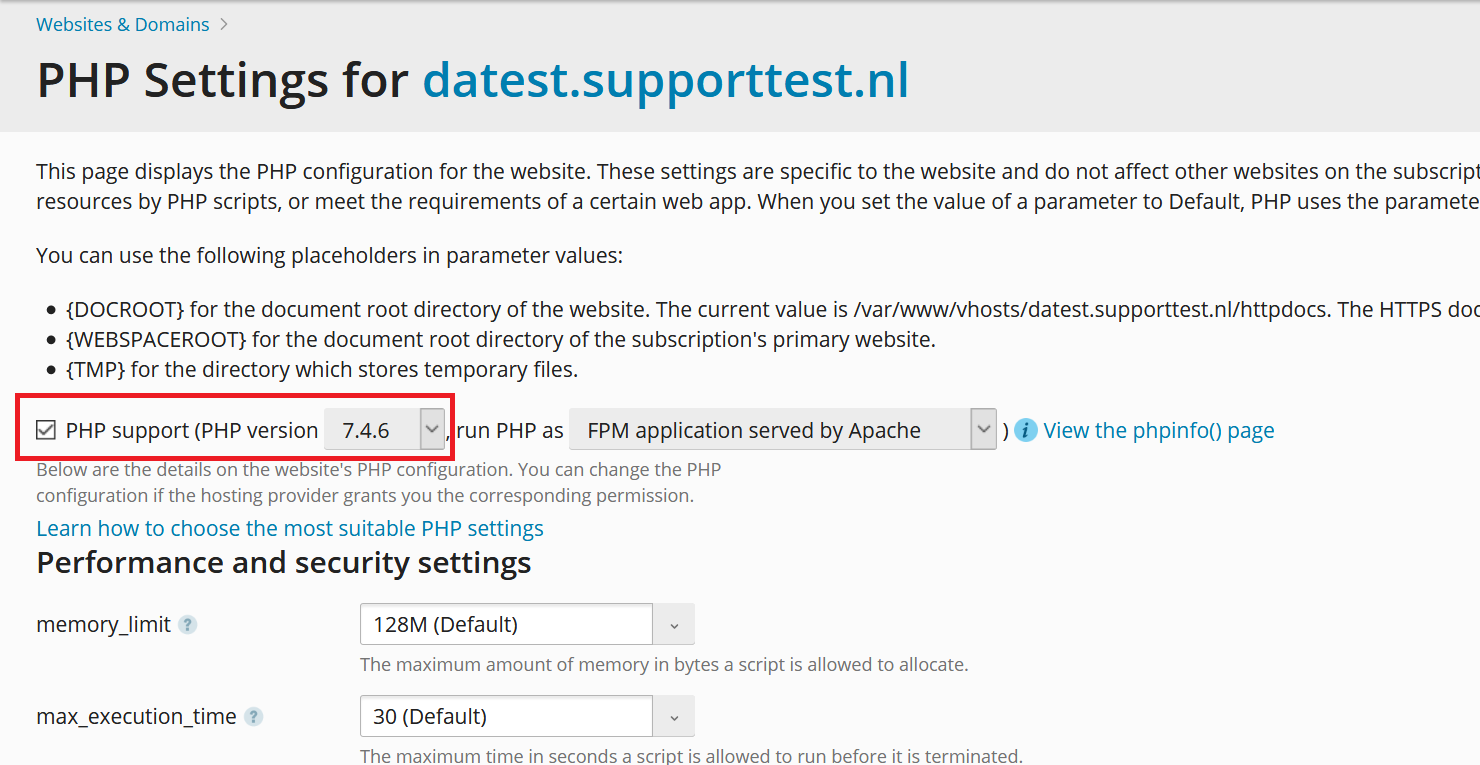
    plesk domain php settings

    You are free to adjust the PHP settings on this page. However, we recommend that you leave / turn PHP-FPM via  Nginx and not use FastCGI as FPM is faster. Additionally, as of Plesk 17.8 PHP-FPM with Nginx new caching mechanics are introduced. These mechanics will provide a significant performance gain for the loading of your websites' static objects and reduce CPU usage.


    Step 3

    You may have noticed that some hard limits have been set, such as a Memory Limit of 128MB. Many CMS systems need more memory. To adjust this, go to 'Tools & Settings'> 'PHP Settings'.
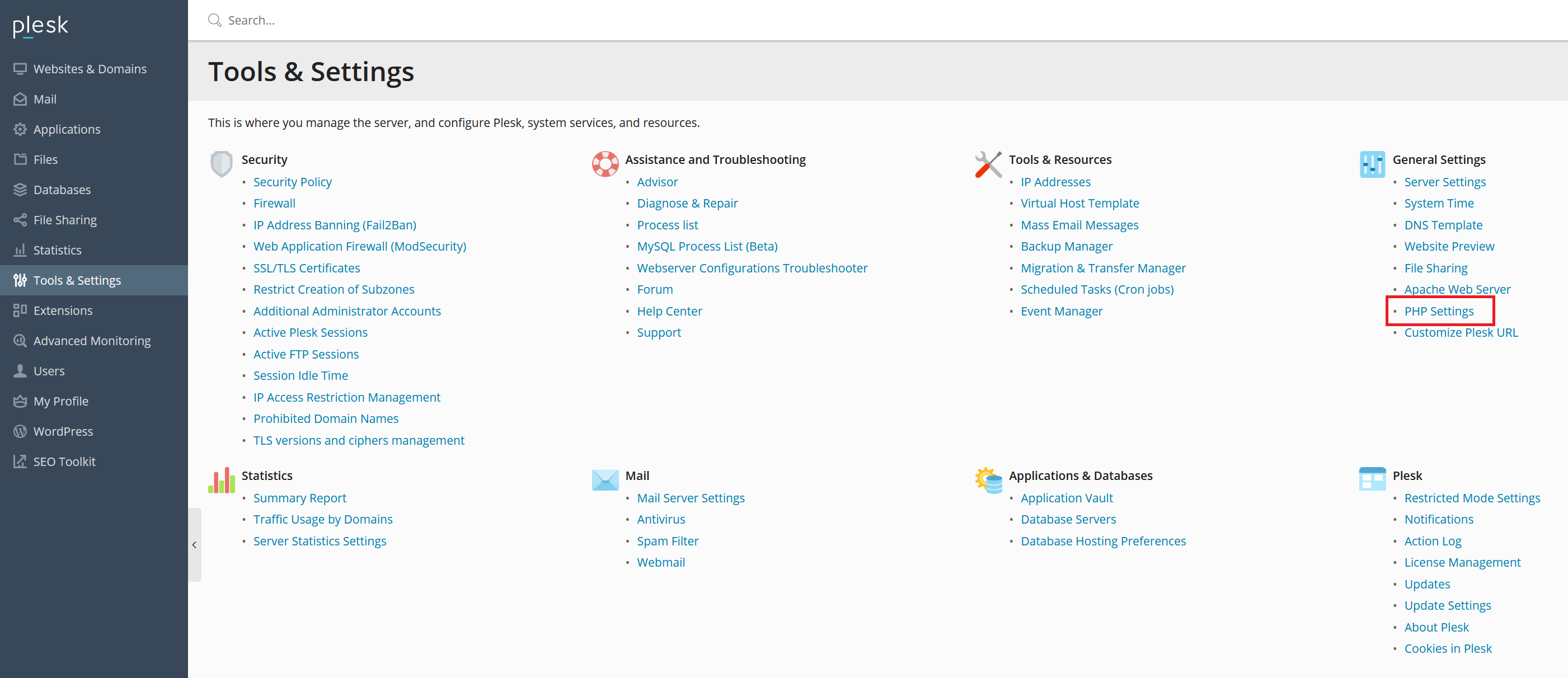
    plesk tools and settings php settings


    Step 4

    You will see an overview of the PHP handlers (a handler is a function that performs a specific task). Click on the number that you set in step 2, for example the relevant PHP FPM application.
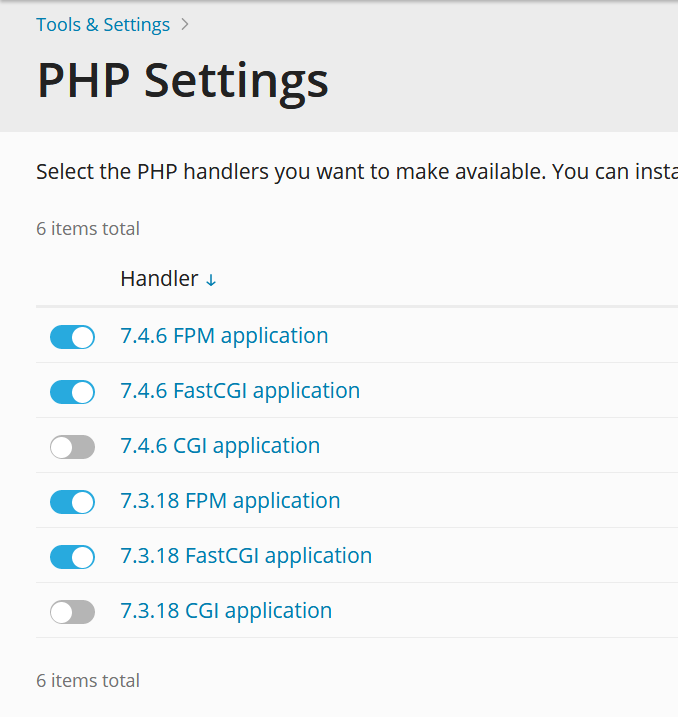
    plesk php settings and handlers


    Step 5

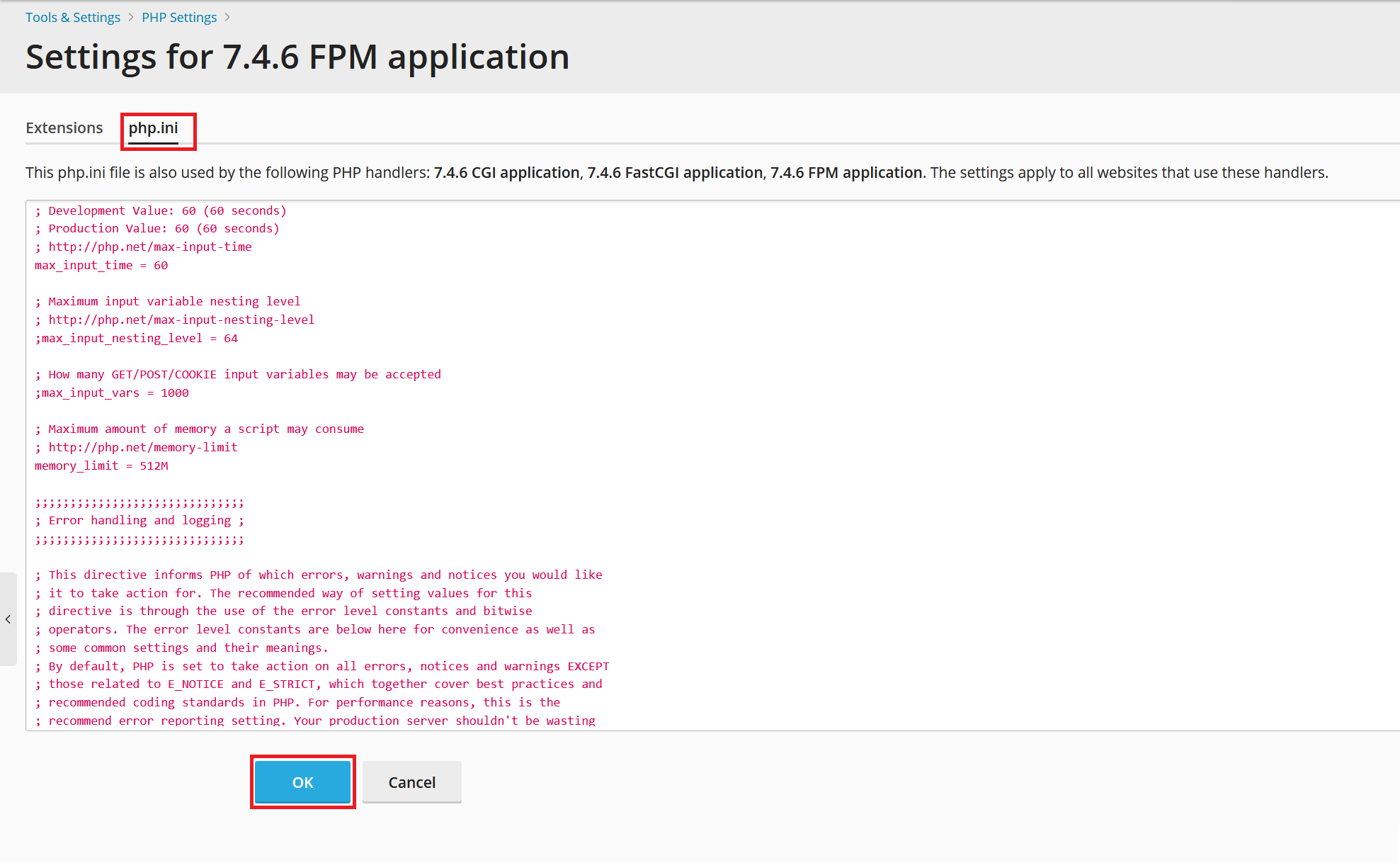
    Click on the 'php.ini' tab. You will now see an overview of PHP settings for your selected PHP handler. Look for the hardcoded limit you want to look up (for example ctrl + f > memory_limit = 128M) and adjust the limit to the desired value. Then click on 'Ok'
    plesk php performance settings

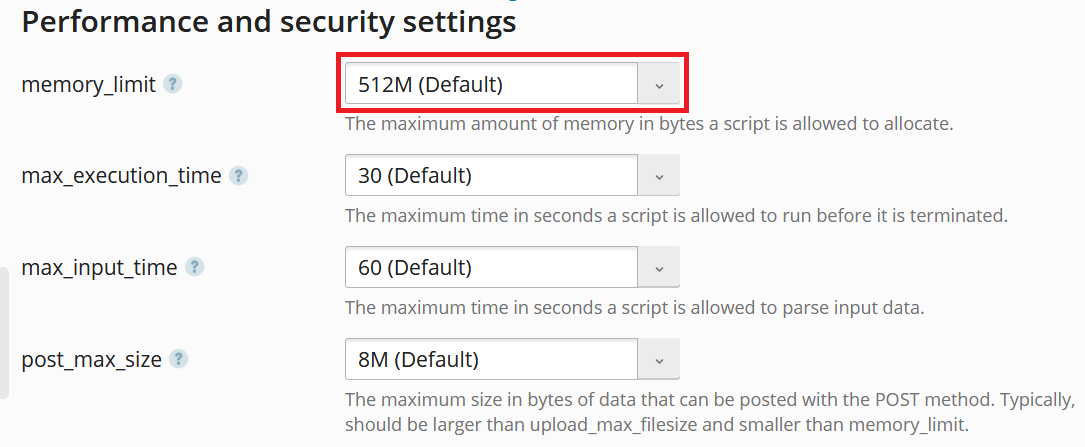
    If you now return to 'Websites & Domains' > 'PHP Settings', you can adjust the value of the custom option. You must enter this value manually, for example by changing memory_limit to 512M. Then click 'Apply' to process the changes.
    plesk php performance settings

    Please note: as an administrator, you can also adjust php.ini values per domain under 'Websites & Domains' > 'PHP Settings'. Those changes only apply to that domain and not to other accounts.


    Plesk automatic updates
     

    Updates are meant to give your VPS more stability, better functionality and security. Plesk updates are performed automatically (usually during the evening) and include the following components by default:

    • Plesk packages and services developed by Plesk (e.g. Plesk Health Monitor and Plesk extensions).
    • Packages of your operating system
    • Third-party components such as MySQL, PHP, etc.

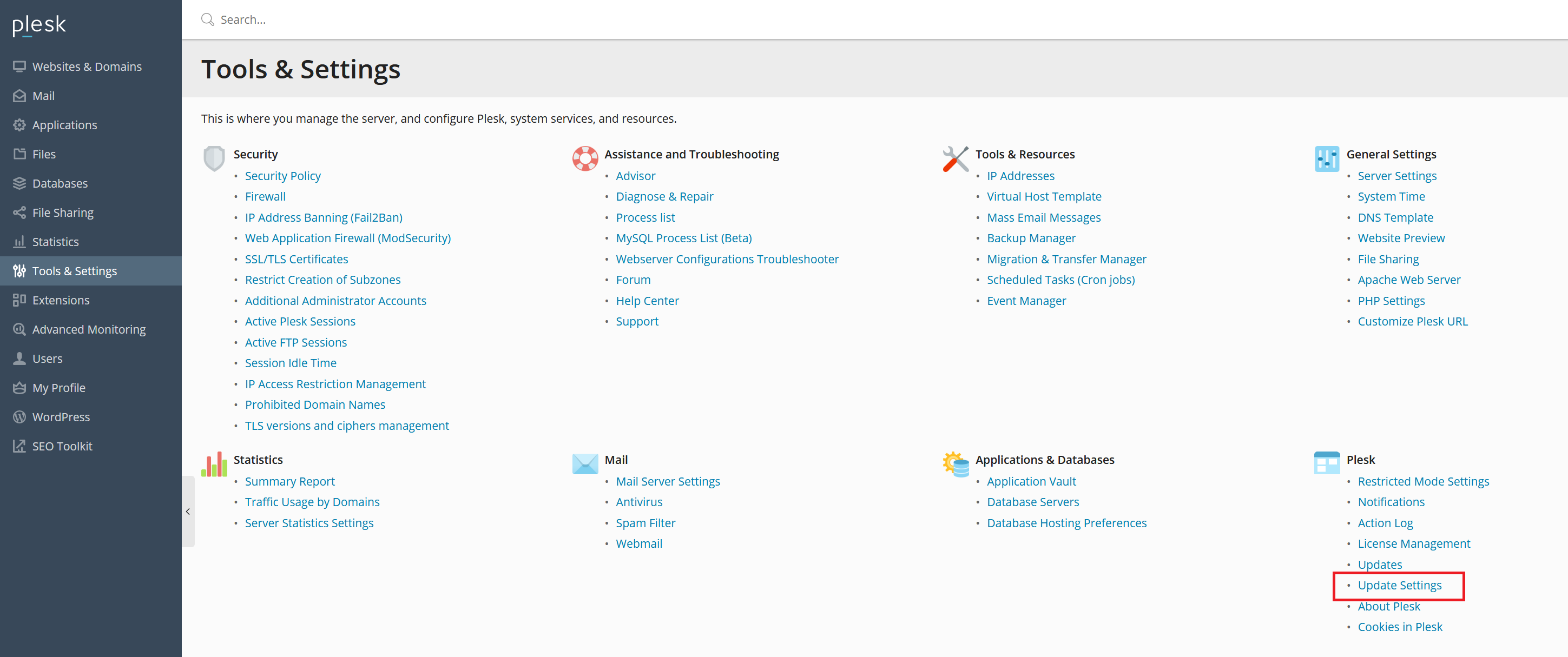
    The settings of the automatic updates can be found under 'Tools & Settings'> 'Update & Upgrade Settings'.

    plesk update and upgrade settings

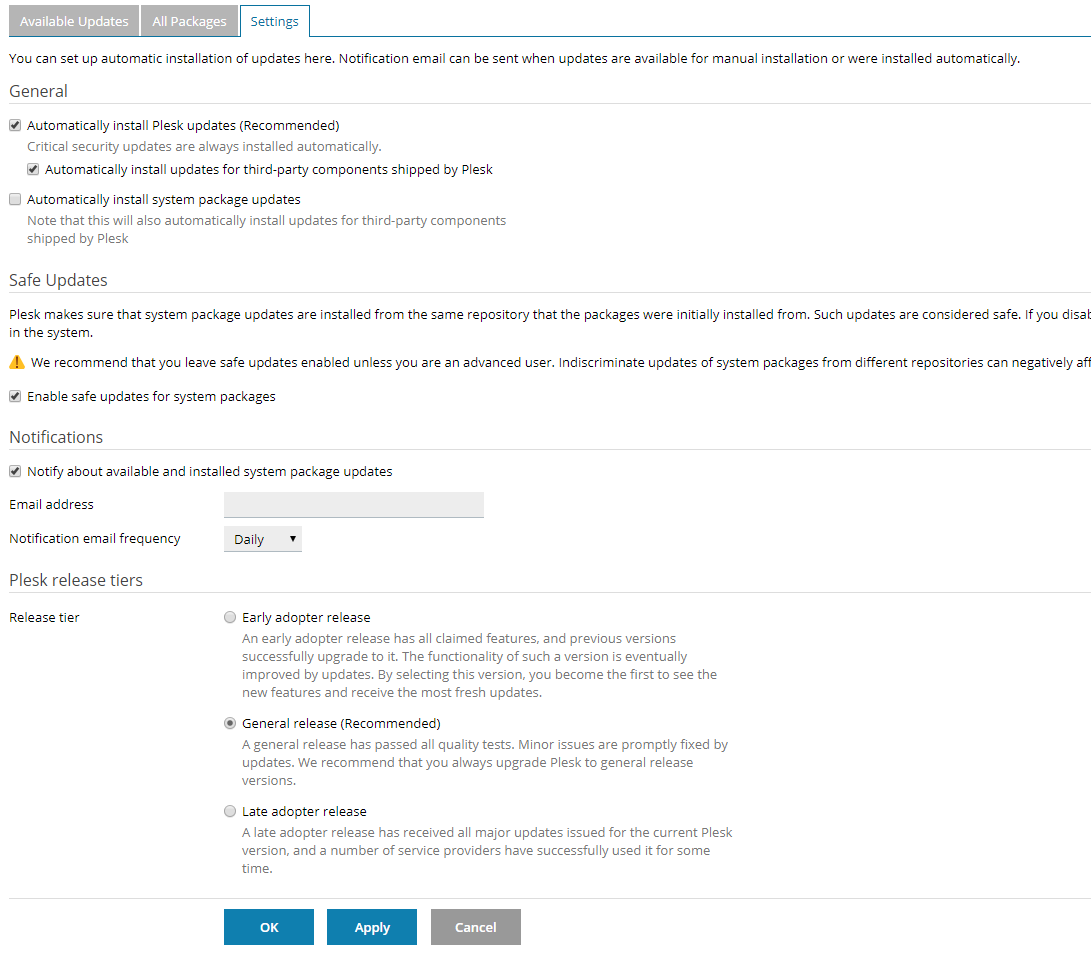
    You will then see the overview below of the update settings. A complete overview of all packages that are automatically updated can be found under the 'All Packages' tab. There are + - 900 packages at the time of writing.

    plesk system updates and settings

    You may have noticed that under 'General' the option 'Automatically install system package updates' is available and may wonder what the differences are between the Plesk updates and the system package updates.

    • The Plesk updates include Plesk packages and services developed by Plesk (e.g. Plesk Health Monitor and Plesk extensions). Optionally you can also include third-party components such as PHP, Apache and Dovecot. This option is enabled by default.
    • The system package updates include all packages for your operating system, but also the above mentioned third-party components.


    Updating Plesk manually


    Plesk itself and components that do not fall under automatic updates (e.g., new PHP interpreter versions, Webalizer, etc.) can only be manually updated from Plesk using the steps below. We advise you to check this with some regularity and to keep your VPS up-to-date as much as possible.

    Step 1

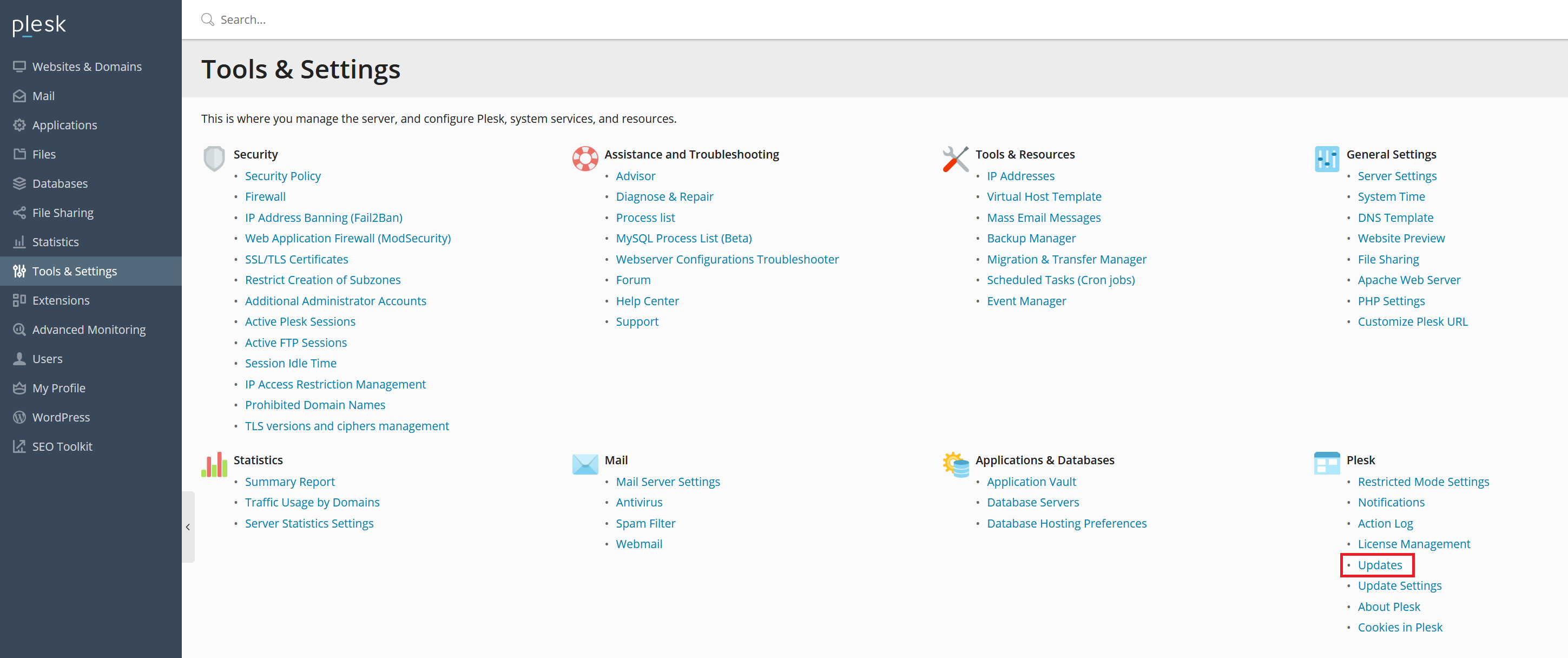
    In Plesk go to 'Tools & Settings'> 'Updates and Upgrades'.

    plesk updates and upgrades


    Step 2

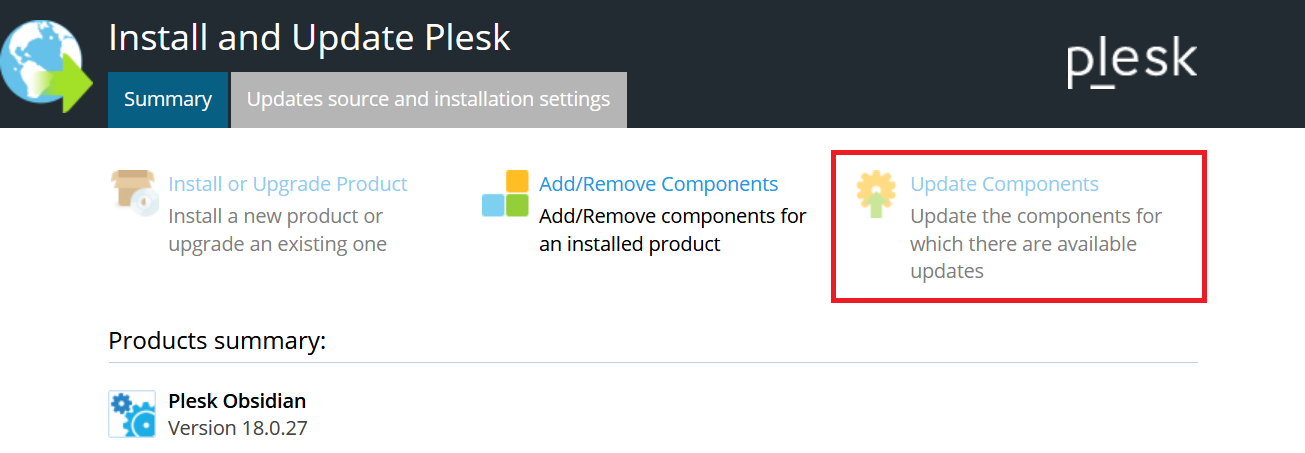
    If there are updates available, you will see an orange exclamation mark 'Component updates are available'. Click on 'Update Components' at the top right.

    plesk update components


    Step 3

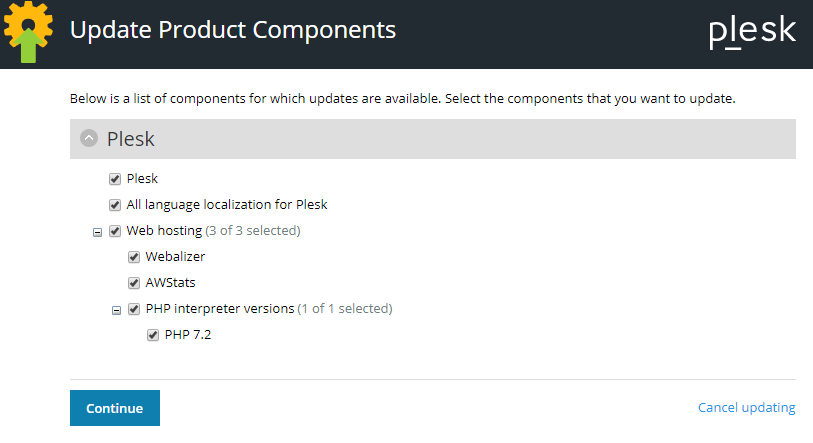
    Select the components you want to update (usually all) and click on 'Continue'.

    plesk update products and components

    Please note that the components you see may differ from those in the example above.


    Your VPS is now not only safe, but also completely up-to-date and you're ready to link a domain! Click here to continue to Part 4: Linking Domains and Subdomains.

    Need help?

    Receive personal support from our supporters

    Contact us